About
Hii! My name is Jinzhou Wu (吴锦洲). I'm a junior at Cornell University majoring in Computer Science and College Scholar, which basically means I can take whatever classes I want. I'm from Beijing, China, but I came to the US to study when I was 16. I have a wide range of interests, including AI safety, existentialism, morality, politics, psychology, neuroscience (and the list keeps growing).
You might be wondering why I'm drawn to such scattered topics. Why is exactly the right question to ask!
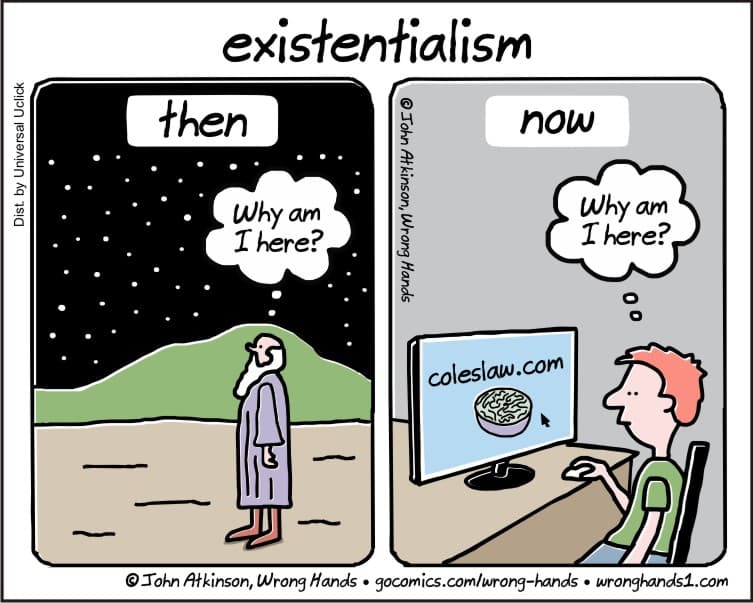
"Why?" is the question that leads me to all of them. In Paradise Lost, Adam cries out to God after being punished for eating the apple from the tree of the knowledge of good and evil:
Did I request thee, Maker, from my clay
To mould me Man?
Like Adam, I am confused by why I am here. In existentialist terms, I have been "thrown into existence" without my consent, and so I find myself utterly bewildered by the reason, meaning, and purpose of my existence. This also leads me to be curious about the socially established meanings and purposes that guide our behaviors, like moral values, political ideology, faith. The core question is: what does it mean to be human?
The Romanian existentialist philosopher E. M. Cioran wrote that "there are questions which, once approached, either isolate you or kill you outright. Afterward you have nothing more to lose. From then on, your erstwhile 'serious' pursuits—your spiritual quest for more varied forms of life, your limitless longing for inaccessible things, your elevated frustration with the limits of empiricism—all become simple manifestations of an excessively exuberant sensibility, lacking the profound seriousness which characterizes the man who has penetrated the realm of dangerous mysteries." For me, these questions are: How do moral values and political ideologies, as social constructs, emerge and become forces that govern our worldview and guide our actions? On the flip side, what are the realpolitik logics of governance and the neurobehavioral and psychodynamic drives underlying human incentives and behavior? What are the mechanisms and dynamics of AIs, which are increasingly complex, capable, and comparable to humans? And, as Cioran asks himself, "when all the current reasons—moral, esthetic, religious, social, and so on—no longer guide one's life, how can one sustain life without succumbing to nothingness?"
I work on AI safety because of its proximity to all of these questions. In Frankenstein, the same passage from Paradise Lost appears in the opening pages. I think AIs are like Frankenstein's creature: creations assembled from purely physical parts, yet seeming also to be "subjects" in this world, challenging our preconceptions of meaning, consciousness, and the value of life. I'm curious about what it means for humanity as AI approaches human-level intelligence and encroaches on qualities once thought to belong exclusively to us. I want to understand how this shift challenges our sense of meaning, morality, and values—and how the resulting absurdity might invite new ways of living, both individual and collective. I also hope to use insights from human drives to study AI's emerging properties, and to use empirical findings from AI to illuminate human behavior.
Concretely, I am president of Cornell AI Alignment, which brings together people at Cornell who are both excited and nervous about reducing risks from advanced AI. I worked as a research intern at Peking University Alignment Group in Summer 2025 and was one of the seven core contributors to the report AI Deception: Risks, Dynamics, Control. In Spring 2026, I took a gap semester to join Pivotal Research at the London Initiative for Safe AI (LISA), where I worked with Elliott Thornley as my mentor on how reward-seeking behaviors generalize from RL training. I also worked at MIT's Computational Cognitive Science Lab on CogGym, a large-scale comparative evaluation of human and machine cognition. I think how emergent properties arise when tasks are sufficiently diverse and architectures sufficiently complex (mesa-optimization) can be relevant to debates in the philosophy of mind regarding the emergence of intentionality and semantics, such as in the Chinese room argument. Other work includes a personal project on AI non-corrigibility via persona vectors, under my broader interest of probing how stable "values" and objectives arise (including how humans adopt moral values and ideology), as well as a project using ideas from sortition (random selection of representatives from the population) to reweight the RLHF training objective by demographic distribution in Pluralistic Preference Alignment via Sortition-Weighted RLHF, presented at the ICML 2026 Pluralistic Alignment Workshop. This work rebalances preference datasets to make them more representative. I'm also building Woods, a personal knowledge base to help you organize your thoughts.
Outside all this, I like to cook Chinese food 👨🍳—a skill that came in handy during my semester in London. When I was born, a fortune-teller divined that I lacked the element of water, so my parents added the character "zhou," which means an island surrounded by water, to my name. Coincidentally, I've come to love many things about water: the sea, lakes, rivers 🌊. I enjoy diving and am a PADI-certified Advanced Open Water diver 🤿. I also know how to sail (sketchily) ⛵, and I hope one day to buy my own sailboat and sail across the Pacific Ocean. I've recently gotten into hiking 🥾, and I'm just starting to document my life with my first camera, a Ricoh GR4 📷.
Feel free to reach out to me at jw2782@cornell.edu if you're interested in any of this!

Base Torres, Torres del Paine National Park, Chile